
For both seasoned therapists and those in training, there comes a turning point in couple and family therapy when a pattern emerges. It’s “the cool moment when the puzzle pieces fit into place,” one doctoral student says.
People who study and teach relational therapy call that moment “immediacy.”
“Something happens in the therapy room where we strike a chord,” said Ohio State’s Ashley Landers, associate professor of human development and family science who teaches the Couple and Family Therapy specialization.
“Something resonated. We hit the jugular, or a pattern that we know exists is now playing out in real time,” she said.
Often, because two or more clients are in the room, the gaps in one person’s story are illuminated by the other. For student therapists, these “a-ha” moments suddenly illustrate why two or more people can perceive the same experience in such different ways.
Those “turning-point” revelations — and the level of complexity they offer — are one reason students find themselves so drawn to couple and family therapy.
“With individual (therapy), there’s a feeling like you’re not getting the whole story sometimes,” said second-year master’s student Langston Myers. “When there’s a couple in the room, you’re getting a little closer to what actually happened.”
This autumn marks 40 years since Ohio State began training graduate students to recognize the “a-ha” moments — offering couples and families insights and tools to achieve healthier, more fulfilling relationships.
The specialization began as Marriage and Family Counseling in 1986, then 2 1/2 years later, a clinic opened that allows supervised students to apply in the therapy room what they learn in courses.
Since then, thousands of central Ohio clients — 1600+ in the last decade alone — have received couple, family and individual therapy while paying affordable, sliding-scale fees.
The specialization has for decades turned out expertly trained clinicians and researchers; an expanded master’s program, with 18 admitted this year, will graduate many more.
“We’ve continued for 40 years without a whole lot of advertising,” said Suzanne Bartle-Haring, professor of human development and family science who has been with the program since 1992. “We get the clients, and we’re out there. When you Google couple and family therapy, we’re the first (clinic) that comes up. I think that’s how people find us, and that’s a success.”
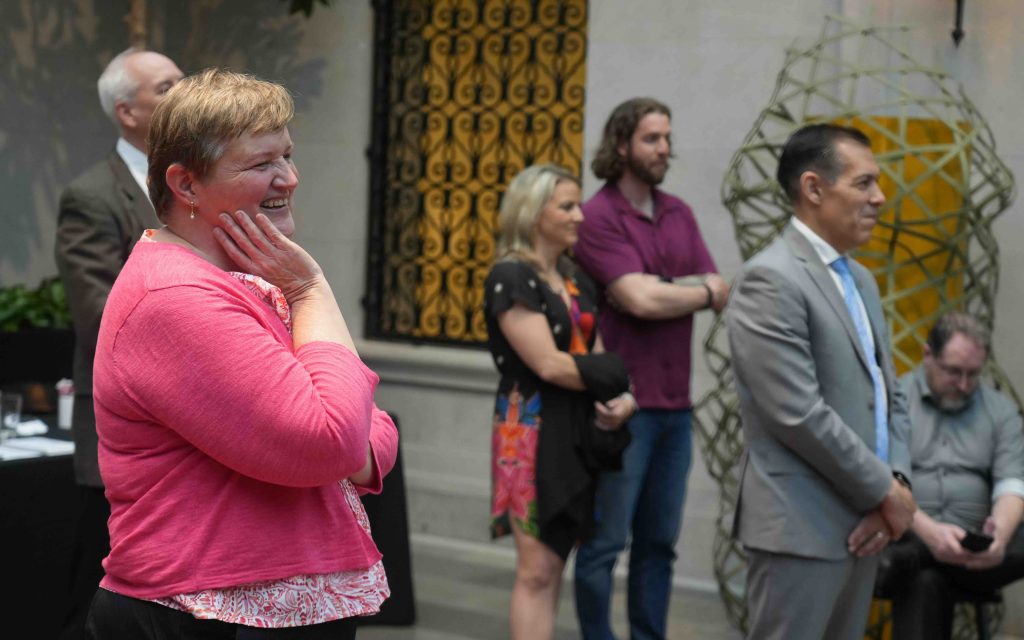
Bartle-Haring retired from the university in late April. The college celebrated her contributions and the clinic’s success May 21 with a fundraiser-auction of hers and others’ art at the Columbus Museum of Art. The funds will help the clinic to rent and equip more space to accommodate its expanding cohort and clientele.
A rich history, including a donated couch
In 1986, Ohio State’s then-Family Relations and Human Development program was nationally recognized. But it lacked one thing.
“(The administration) charged me with developing a marriage and family therapy component to the PhD program,” said Geoffrey Leigh, who was hired from University of Iowa that year by Acting Chair Patrick McKenry.
Leigh, a clinician certified by the American Association of Marriage and Family Therapy, began teaching systemic therapy theories and obtaining approvals to open the clinic, which included a camera and a one-way mirror so that faculty could supervise sessions.
“We started in Mount Hall, in the basement, with four rooms and hand-me-down furniture from (the first) 12 students,” Bartle-Haring said. “I think we had a peach couch in one of the rooms forever.”
Alison McArthur, ’91 MS, ’94 PhD, had previously worked in individual addiction counseling. She was among the first cohort.
“That was a magical time,” she said. “It was exciting to be involved in program development and learning the systems therapy approach.”
A family might seek counseling because their son was acting up.
“A ‘problem child’ might be holding a (faltering) marriage together by acting out and giving the couple a reason to pull together to manage (his) behavior. Or one family member might be colluding with another to negate anything he says,” McArthur said.
The cohort would then discuss: Who has the power? What is the meaning of his misbehavior?
“The videotaping and one-way mirror allowed us to discern family dynamics that can be missed,” she said. “The body language of family members and the skill of managing several family members or a couple can add valuable information to the therapy process.”
Such training shaped McArthur’s expertise; she has since been in private practice for nearly 30 years.
“It was a rich learning experience that expanded and deepened my therapy skills,” McArthur said.
The reasons for therapy aren’t going away
The dynamics of couple and family therapy have changed somewhat in 40 years, said Ashley Hicks, clinical associate professor and director of the clinic since 2021.

“One of the shifts is people’s engagement with psychology through popular culture,” she said. They might be familiar with terms like narcissism and “cut off,” but don’t necessarily understand the implications.
“Therapy” is no longer a dirty word. Most — if not all — of the faculty and students trained by the college are consumers of therapy themselves, Landers said.
Also, “diversity and couple constellations — like open relationships and polyamorous relationships — are more openly common now than before,” Hicks said.
But the need and root causes of relationship distress have not changed.
“People are always going to be navigating presenting problems: family life-cycle events like coupling, preparing for marriage, having a child, parenting young children, launching your children, retirement, empty nesting,” Landers said.
Unexpected life events such as infidelity, grief and co-parenting also continue to nudge people to seek therapy.
“No family is untouched,” Landers said. “So, training the next generation of clinicians who are well-positioned to work with families navigating concerns like divorce or children’s behavioral problems or an affair is really important.”
The demand for the therapists remains high, and the clinic has never lacked clients. Nationally, couple and family therapy ranks 38th in U.S. News and World Report’s 100 Best Jobs and No. 4 for social science positions.
The Bureau of Labor Statistics projects 12.6% employment growth for the profession between 2024 and 2034, with an estimated 9,800 job openings.
To help meet the need and expand its impact, the college opened a master’s specialization in couple and family therapy in 2019.
“When I was a student, we probably had, at maximum, 10 student clinicians at a given time,” said Hicks, ’11 MA, ’16 PhD. “As of January, we have 27. So how many clients we can serve has shifted quite a bit since 2019.”
In 2025, new clients increased by 42% over the previous year as more student clinicians became available to counsel them. The autumn 2026 student cohort will expand client-reach even more.
Also, the master’s specialization was accredited by the Commission on Accreditation for Marriage and Family Therapy Education in 2025. (One Ohio State doctoral student calls the endorsement “the gold standard” for graduate programs and a major draw for students.)
The master’s and the PhD specializations are two of only three accredited programs in the state. That points to the program founders’ rationale for starting the clinic in 1989.
“No matter how much knowledge we impart in the classroom, the moment you walk into the therapy room … it’s like you just have amnesia, because you have to actually apply what you learned,” Landers said. “Where do you learn to be a therapist? You learn to be a therapist in the room with clients.”
“Ultimately, time in the room, in therapy, is how you refine your therapeutic practice.”

A career devoted to understanding relationships
In February, Bartle-Haring spoke to 20-some master’s students about Bowen family systems theory. It was the last course she taught in her 34-year Ohio State career.
What if a client confirms a suspected affair? (It’s not uncommon in couple therapy, Bartle-Haring says.) She cautioned students not to get “spun up” in the emotion of the therapy room.
“Most of your work, if you’re going to use this theory, is to calm them down and slow them down so that they start to be able to think — and feel,” she said. “For the most part, what we have are people feeling. They’re pouring out their stuff … if we’re not pitching into the bucket (too), we’re much more helpful.”
It’s sage advice from Murray Bowen, the pioneering American psychiatrist and theorist with whom Bartle-Haring has aligned her career.
Much of her scholarship considers what Bowen called “differentiation of self.” In a nutshell, that means maintaining a solid sense of who you are while also staying connected to others, especially in emotional or high-conflict situations. Highly differentiated people can think rationally under stress instead of reacting emotionally — precisely the job of a therapist, but also of a parent and, ideally, a partner.
Most university-affiliated clinics collect data, but publishing that research is rare, Bartle-Haring said. Together with Professor Keeley Pratt, she and the program were cited as the most productive published research team of any accredited marriage and family therapy program in 2018. In 2023, Bartle-Haring was awarded for her cumulative research contribution by the American Association for Marriage and Family Therapy.
She has been a force in the field, Pratt said. “She’s been a tireless advocate for the growth and for the expansion of the program. She did what needed to be done to keep it afloat, regardless of the sacrifice that made to her time.”
“She’s like a quiet powerhouse,” Landers said, “doing all the work that so many (others) would have done with a lot of noise. Suzanne did quietly.”
Painting for the program
Bartle-Haring’s mother was a painter, and she herself took up the brush several years ago, creating mostly landscapes that make the viewer look inward. The act of painting, you could say, was a means to her differentiated self.
“We hear about mindfulness,” she said. “The connection for me is that painting takes me out of myself. I’m completely present in the moment. There’s nothing to distract me.”
When she decided to retire from Ohio State, she chose to donate 10 oil paintings to raise funds for the clinic. Other artists have offered their work as well. The Couple and Family Therapy 40th Anniversary Fundraiser, May 21 from 6-9 p.m. at the Columbus Museum of Art, will help secure more space for the expanded cohort and provide necessary equipment and furniture for new therapy rooms.
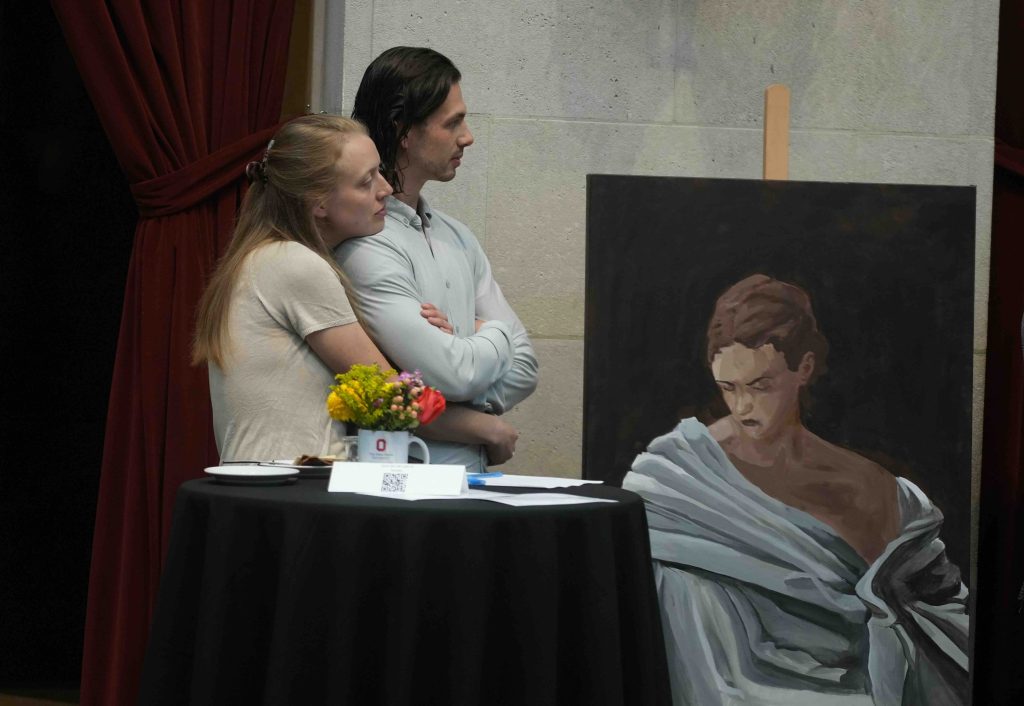
“If we want to help people, if we want better mental health, we have to find ways that we can do that,” Bartle-Haring said.
One way is to equip more practitioners, researchers and new faculty, multiplying the impact outward while helping those in personal or relationship distress. If all of Ohio State’s current 22 master’s students become therapists and serve 20 clients per week, the community will receive 22,000 therapy sessions each year.
By any measure, the potential for “a-ha” moments is boundless.